


Yellow Legged Asian Hornet
You may have seen in the news over the last year or two about an “Asian hornet’. Officially called the Yellow Legged Hornet (YLH), partly as a helpful descriptor (they’ve got yellow legs!) to make their key features more memorable, but also to distinguish it from other Asian hornets such as the Giant Asian Hornet which is causing problems in North America. The YLH has been causing problems in France since 2004 but didn’t manage to cross the channel until about 10 years ago when there were a small number of annual incursions which were often either lone hornets (drones (male) or workers (sexually immature females), or queens which established nests which were thankfully found and destroyed before they could release too many new queens. But since 2023 when 72 nests were found, there have been an ever-increasing number of individual hornets and nests found, with 544 credible sightings and 161 nests found and destroyed in 2025.
Why is this a problem?
YLH prey on other insects and have a voracious appetite, a single nest can consume over 11kg of insects in a season. Honey bee hives/nests are essentially an all-you-can-eat buffet which the hornet has developed a distinctive behaviour to take advantage of; hovering in front of the hive, facing away from the entrance in order to snatch returning bees out of the air. The YLH then chews the bee’s head and abdomen off as it’s only interested in the protein-rich, muscle packed thorax. Whilst this obviously has beekeepers concerned, it will impact many more insects than just honey bees as the YLH isn’t particularly fussy about its diet and will choose to forage wherever there is a high density of insects. In fact the paper below has shown that the density of insects on ivy (a plant which flowers late in the season when there are few other forage options for insects and therefore attracts a wide variety of wasps, flies and bees in high numbers) can attract YLH and decreases the pollination of the ivy. The pollinators either make their visits as quick as possible to avoid being picked off by the hornet or alternatively avoid the ivy all together, thereby missing out on a crucial late season source of food.
The YLH has an interesting lifecycle, not too dissimilar to our native European hornets or wasps but with a cunning extra step that can make controlling them a little more difficult. The YLH queen builds a primary nest between March-April, often low to the ground, in bushes or hedges. She rears her initial clutch of brood until she’s hatched enough workers to take over the brood rearing and foraging duties, then she focuses most of her time simply laying eggs. The primary nest may be more sheltered in its location, however this can limit the expansion of the nest and therefore the hornet colony. So later in the year, around June-August the YLH colony may move to a secondary nest this time located higher in the treetops. The colony takes some time to move over and for a short time they will have 2 viable nests, which can mean if one nest is located and destroyed, the hornets simply stay with the 2nd nest. This can make the hornet eradication more difficult during this period.

From around August onwards, the hornets become much more active, and it is here where members of the public can be of most use in monitoring for them. As more and more forager hornets are out looking for food, their predatory nature comes to the forefront, but this can be used to our benefit. Bait stations can be used to attract foraging hornets by providing a source of food - specialist solutions can be purchased but jam and water mixed to make a sugary mixture also works and is more readily available! Provided the bait station is monitored regularly throughout the day, any hornets seen can be photographed and evidence of the sighting can be submitted to the Asian Hornet Watch app or online form:
It is recommended to put the bait solution in a clear plastic window mounted bird-feeder, on a window you pass regularly, such as the kitchen window. This will allow you to monitor the trap while you’re making a cup of tea, or your dinner! Most importantly you should not set ‘kill-traps’ designed to catch and kill the hornets though this may seem tempting, the live hornets can lead the government YLH monitoring teams back to the nests where they can destroy the entire nest instead of a small number of individuals. Kill traps are also quite bad for other pollinators as they don’t discriminate so can trap and kill bees, wasps, flies and butterflies, all of which are beneficial insects who have important roles in our ecosystem.
The foragers will continue to be active into November/early December although by this time the nest will be winding down after producing up to 750 new queens. The nests will eventually dwindle and die out over winter, but the new queens will hibernate through the colder months, emerging in March-April ready to start the cycle over again.
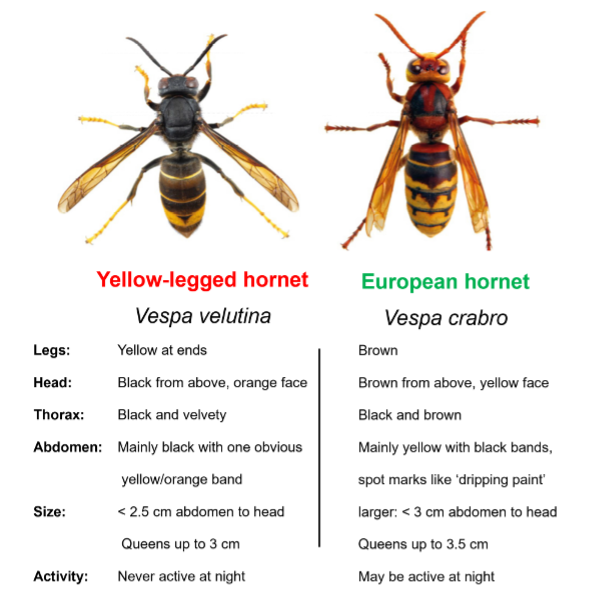
Image: The National Bee Unit
I suspect that completely eradicating the hornet in the UK is no longer possible, their method of entering the country through boat and train travel from France is likely too difficult to monitor effectively to prevent repeated incursions. In addition, the increased nest numbers and some genetic testing indicates that queens who have overwintered have successfully founded new nests the following year. So, efforts must now move to control, keeping the numbers as low as possible so the impact on our native pollinators isn’t too overwhelming.
References:


This was such a fascinating (and slightly alarming) read I had no idea the Yellow Legged Hornet builds two separate nests in a season, which makes eradication so much trickier if one gets destroyed! The point about kill-traps harming other pollinators like bees and butterflies was really eye-opening too, since monitoring bait stations seems like a much smarter approach. It's a good reminder that even here we've had to bring in Pesticon's hornet removal service in Langley when nests got established near beehives. Really informative post overall!